Kate Ryan’s maternal exhaustion
Firefly LaneKate Ryan’s maternal exhaustion is the accumulated strain of caring for children while trying to retain a self beyond motherhood. It begins in the intimate, repetitive demands of early parenting and later expands into a life crowded by school runs, housework, and competing obligations. The novel does not present this fatigue as a simple failure of patience: it shows how sleeplessness and unrecognized labor can make a loving parent feel trapped, and how relief becomes possible when Kate finally says plainly that she needs help.
Early Motherhood and Sleep Deprivation
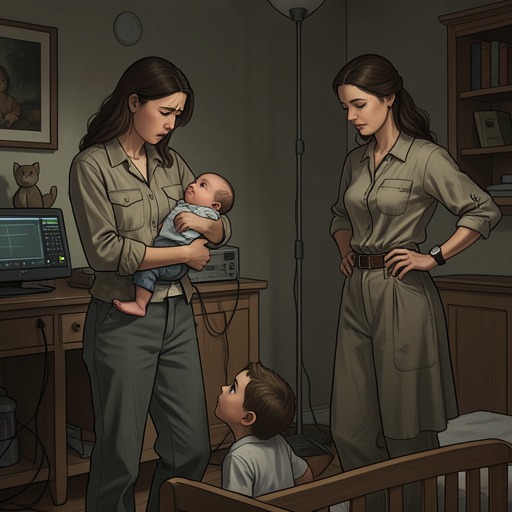
When Marah is an infant, Kate’s days and nights are organized around a child who is frequently ill and difficult to settle. Ear infections follow one another, and colic leaves Marah crying for hours. Kate sometimes finds herself holding her daughter in the middle of the night and crying too. With Marah not yet a year old, four hours is the longest stretch she has slept; for twelve months, Kate has not slept through the night.
Johnny offers to get up with the baby, but Kate stops him. Her reasoning is shaped by the division of their lives: Johnny has a job, while Kate has given up her career to be a mother, so she treats nighttime care as her responsibility. What begins willingly, and even with a smile, has become a task she meets with prayers for strength when Marah wakes at eleven. The routine makes the cost of care concrete: Kate’s exhaustion is not a single crisis but a nightly obligation repeated without a full night’s rest.
That burden also affects how Kate sees herself. She connects her changed appearance to the continuing lack of sleep and describes having worn sweats for nearly a year. Finding her old Jane Fonda workout tapes, leotard, and leg warmers gives her a possible route back toward taking care of herself, but the evidence leaves the next step at the threshold: she has not yet pressed play. The tapes register both a wish to reclaim time for her own body and the distance between wanting a change and having the energy to make one.
Friendship and the Work of Care
Kate’s capacity to support someone else appears well before the later demands of parenting. After Tully begins to cry, Kate approaches and hugs her. The contact initially catches Tully off guard, but she cannot pull away; she clings to Kate, afraid of losing the person who is holding her. In another encounter, Tully tells Kate that she has been raped. Kate’s quiet question about whether Tully is okay answers the disclosure with concern rather than blame. These scenes establish a form of care rooted in presence: Kate offers comfort without requiring Tully to first make her pain easy to discuss.
When Kate asks whether Tully is all right, Tully tells her that her grandmother has died. Kate holds her as Tully sobs, giving her the sympathy she has been waiting for. The exchange shows care moving between the friends: the person who once sheltered Tully is now able to receive support from her, although that reciprocity is not yet a solution to the unequal demands of motherhood.
The friendship becomes harder to sustain as their daily worlds diverge. Kate feels that Tully does not want to hear the repeated details of being a mother, while Kate can only take so many accounts of Tully’s successful career. Tully’s postcards and calls from distant places add to Kate’s sense that they have little in common. The contrast does not mean that either friend has stopped caring; it shows how exhaustion and different circumstances can narrow the space in which their lives meet.
A Crowded Life and a Claim to Selfhood
By 2000, Kate is raising a ten-year-old daughter and twin boys under two. The age gap makes family life feel divided into almost two households, and she understands that starting over with young children has renewed and intensified the exhaustion of motherhood. Her ordinary day runs from sunrise until well after sunset, filled with chores that accumulate faster than she can complete them. Although she has almost no hour to herself, she feels she accomplishes little of lasting importance. The image of a race with no finish line captures the contradiction: constant work without a clear point at which the work is done.
Kate’s responsibilities include more than caring for the children. She describes Marah as involved in sports, dance lessons, and a crowded social life, while the twin boys rarely sleep at the same time and break what they touch. Dinner, laundry, cleaning, and writing a book all compete for the same hours. Kate also recognizes that she wants more than motherhood and wants to write, but cannot see how to meet that need while remaining on time for the carpool. Her weariness is therefore tied to a conflict between the work she loves and the disappearance of time for her own ambitions.
The visit from Tully and Johnny gives Kate’s unspoken overload a witness. After Kate voices the demands she is carrying, Tully challenges the assumption that she must manage all the household work herself. Kate realizes in that moment how overwhelmed she has been. When she admits that she needs help, relief loosens the tension in her back; Johnny draws her close and tells her she only had to say so. The scene marks a change from privately enduring the workload to naming a need and allowing her husband to respond. It does not erase the demands, but it makes their unequal arrangement discussable.
Separation, Crisis, and Continued Care
Kate and Tully’s differing lives remain a source of friction. During the Gulf War, Kate hopes that Tully is right that the war will not last long and that Johnny will return before Marah takes her first step. Her hope is bound up with the responsibilities of caring for a young child while her husband is away. Later, when Johnny is gravely injured, Tully tells Kate that she could protect her through an exclusive interview. Kate rejects the offer, blaming the news world for the circumstances that have put Johnny’s life at risk. In this conflict, the friends’ shared closeness meets the opposing demands of Tully’s journalism and Kate’s family’s privacy.
Their differences also surface in the way they understand Marah’s choices. When Tully offers to accompany Marah to modeling school, Kate insists that she is Marah’s mother and that keeping her safe is her responsibility. Tully replies that safety is not everything and that some risks must be taken. The argument brings their contrasting instincts into focus: Kate is attentive to the dangers her daughter may face, while Tully is more willing to support an uncertain opportunity. It also reflects how care, whether offered by a parent or a friend, can become conflict when the people involved disagree about what protection requires.
At another point, Tully intervenes publicly in Kate and Marah’s relationship, telling Kate that both mother and daughter need help and that Johnny had asked her to intervene. The gesture is intended as support, but it places Kate’s family conflict before an audience. It repeats the strain that appears throughout their friendship: Tully’s impulse to act on behalf of someone she loves can collide with Kate’s need to be treated as the parent and to retain control of her own life.
When Kate is dying, care takes a different form. Before leaving her television program to be with her family, Tully explains that real life is with friends and family and that Kate needs her. On Kate’s last night in the hospital, Tully persuades Johnny to take the children home, moves a bed beside Kate’s, and brings a recording of her final show. Kate jokes about whether that is what a dying woman wants to watch, but the two watch it together like girls at a sleepover. When Kate asks Tully not to treat her as if she is dying, she explains that she needs Tully to remain herself because that is how she remembers who she is. In this last exchange, their friendship offers companionship without pretending that illness has not changed Kate; even as the care cannot remove the coming loss, it helps preserve the person Kate understands herself to be.